
The Impact of Industrial Pollution on the Environment and 11 Worker Health, and Strategies for Its Control
Industrial pollution and the emission of dust and suspended particles can impact the environment and working conditions for employees. Utilizing industrial extraction systems, exhaust fans, dust collectors, and bag filters represents a key strategy for controlling and reducing these pollutants.
Industrial environmental pollution is one of the major challenges facing manufacturing units, and the control of dust and industrial pollutants plays a crucial role in protecting the environment and safeguarding the health of employees.
Industries play a vital role in economic development and the production of goods essential to society; however, the operations of many industrial units can generate dust, suspended particulates, and other pollutants. Beyond affecting air quality and the area surrounding the facility, industrial pollution—if left uncontrolled—can create adverse conditions for employees and the work environment.
For this reason, the use of appropriate equipment for collecting pollutants and controlling their emission is a key aspect of the design of industrial ventilation and pollution control systems.
How is environmental pollution caused by industries?
Various industrial processes—such as crushing, milling, material transport, cutting, mixing, firing, and the handling of raw materials—can lead to the emission of dust and suspended particles into the environment.
The quantity and type of pollutants generated depend on factors such as the type of industry, raw materials, the production process, and the methods of material transport and discharge.
If these pollutants are not collected at the source, they may disperse into the production hall and be transported to other areas via airflow.
The Impact of Industrial Dust on the Workplace
The presence of dust in production halls not only causes contamination but can also degrade the quality of the work environment and increase the need for cleaning equipment and surfaces.
In certain industries, the accumulation of dust on equipment can also impair the proper functioning of machinery. Therefore, dust control is not merely a matter of managing plant emissions; it must begin at the source where the pollutants are generated.
The Impact of Industrial Pollution on Employee Health
Workers in certain industrial units may be exposed to dust and airborne particles during working hours. The severity of this exposure depends on the type of pollutant, its concentration, the duration of contact, and environmental ventilation conditions.
For this reason, the proper design of an industrial extraction and pollutant collection system—positioned as close as possible to the source of generation—is a key strategy for reducing dust emissions in the workplace.
Of course, pollution control equipment replaces safety requirements and Occupational Health ...are not [sufficient] and must be used alongside other control measures.
What is an industrial suction system?
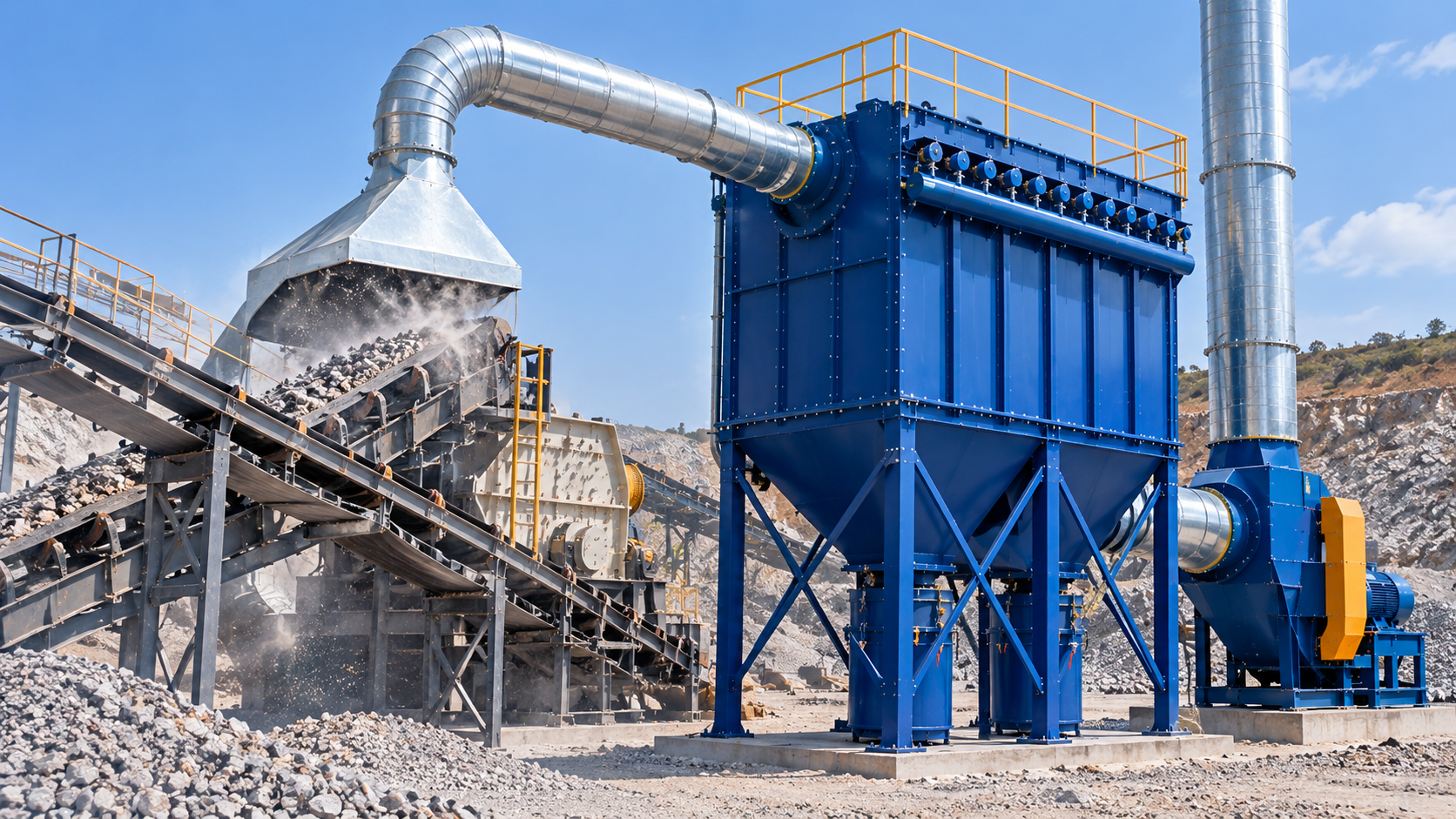
An industrial suction system is a set of equipment designed to collect and transport contaminated air and particles generated during industrial processes.
This system typically includes components such as:
Hood or suction point
Air distribution ducting and piping
Suction fan
Industrial Dust Collector
Bag filter or filtration equipment
Dust discharge and collection equipment
It is.
The proper design of these components is of great importance, as the fan capacity, duct dimensions, air velocity, and type of dust collector must be selected to suit the industrial process.
The Role of the Exhaust Fan in Emission Control
The industrial exhaust fan is responsible for generating airflow within the system. By creating a pressure differential, it directs contaminated air from the source of generation toward the collection and filtration equipment.
Selecting the appropriate fan depends on factors such as airflow rate, static pressure, duct length and diameter, the number of elbows, and the equipment located along the path.
Therefore, the selection of a fan is not based solely on motor power; the entire suction system and its pressure drop must be calculated.
Industrial Dust Collector and bag filter
The industrial dust collector is a key piece of equipment in dust control systems. It is used to separate particles from the airflow and prevent their release into the environment.
In many industrial applications, the bag filter is a common filtration method for collecting suspended particles. In this system, dust-laden air enters the filter housing, and particles accumulate on the surface of the filter bags.
The filter type, number of bags, filtration area, air velocity, and filter cleaning method must be selected based on the type and quantity of dust.
The Importance of Industrial Filtration
Industrial filtration is a key step in pollutant control across many manufacturing processes. The goal of filtration is to separate particles from the airflow and reduce their release into the environment.
To achieve optimal performance, simply installing a filter is not enough; the integrated design of the hood, ductwork, exhaust fan, and dust collector is crucial.
In other words, the final performance of the emission control system depends on the coordination of all its components.
Strategies for Reducing Industrial Pollution
A range of measures can be considered to reduce pollutant emissions in an industrial environment:
Precise identification of dust sources
Installation of hoods and appropriate extraction points at the pollutant source.
Proper design of an industrial suction system
Using an exhaust fan suited to the system's requirements.
Selecting the Right Industrial Dust Collector
Use of Bag filter and filtration equipment suited to the type of particles
Regular servicing and maintenance of equipment
Periodic assessment of system performance and suction capacity.
Preventing leakage in ducts and equipment
Compliance with occupational health and safety requirements
Conclusion
Industrial environmental pollution is an issue that must be addressed starting from the design stage of production processes and emission control equipment. Controlling dust at the source, utilizing appropriate industrial extraction systems, and routing contaminated air to filtration equipment can play a significant role in managing particulate emissions.
The proper use of exhaust fans, industrial dust collectors, bag filters, and industrial filtration systems—combined with regular maintenance and adherence to safety and environmental requirements—can help create a better working environment and improve the control of industrial pollutants.
Isatis Machine Danesh va Sanat operates in the field of designing and manufacturing industrial machinery and systems, including equipment related to suction and pollution control.