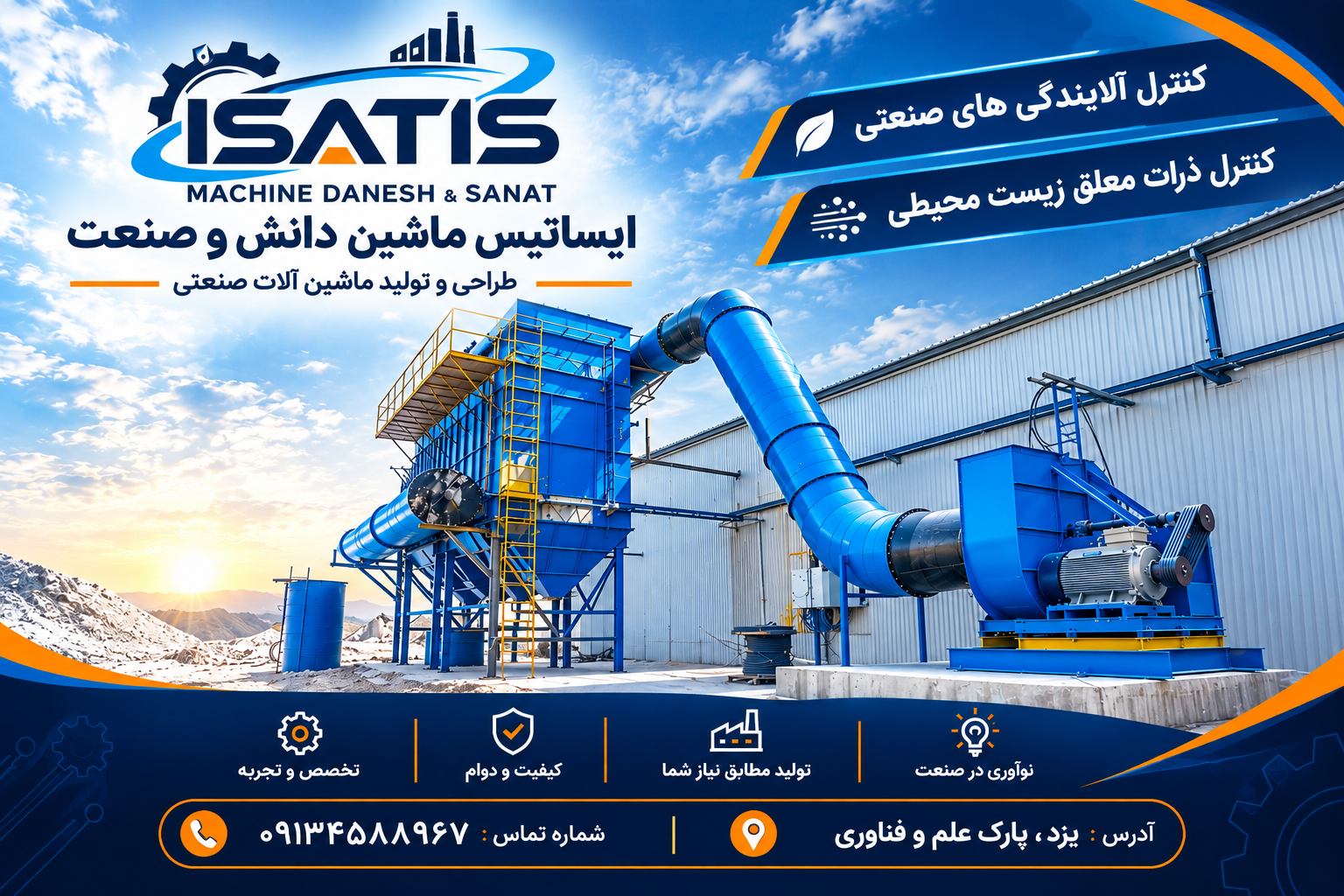

Environmental pollution from iron, steel, and sand and gravel plants.
Reviewing sources of emissions in the iron, steel, sponge iron, and pelletizing industries, as well as sand and gravel plants, and introducing engineering solutions for pollution control, industrial extraction, and filtration./p>
Introduction
The development of industries and the expansion of production capacity in sectors such as iron and steel, iron ore processing, the production of sponge iron and iron ore pellets, pelletizing, and sand and gravel plants play a vital role in economic growth and the supply of raw materials for various industries. However, without adequate pollutant control systems, the operations of these industrial units can lead to increased emissions of dust, suspended particulates, and other pollutants into both the workplace and the surrounding environment. One of the major challenges facing large-scale industries is environmental pollution resulting from the emission of dust and suspended particulates during various stages of production.
Environmental pollution associated with industrial plants is not merely an issue concerning the area immediately surrounding the facility; it can also impact workplace air quality, employee health, environmental hygiene, and the quality of life in neighboring communities. Consequently, identifying pollutant sources and employing appropriate equipment for their collection and filtration constitute a vital aspect of environmental management in industrial units.
Studies on the iron and steel industries indicate that various production processes can be significant sources of particulate matter emissions, and that the simultaneous control of smoke and dust emissions from stationary sources and fugitive emissions is of great importance.
How is environmental pollution caused in industrial factories?
In many industrial plants, a significant portion of air pollution is generated in the form of suspended particles and industrial dust. These particles may be released into the ambient air during the handling of raw materials, crushing, granulation, screening, stockpiling, unloading, transport, and production processes.
In iron and steel-related industries, activities such as raw material preparation, iron ore processing, pelletizing, material handling, smelting, and other production stages can serve as various sources of particulate emissions. The characteristics and composition of the dust also vary depending on the type of raw material and the production process.
Environmental studies conducted on the iron and steel industries have shown that particles emitted from these sectors can contain various compounds and elements; therefore, controlling and monitoring particle emissions is of particular importance for protecting human health and the environment.
Pollution in the iron and steel industries
The iron and steel industries involve a complex set of processes. From iron ore mining and processing to raw material preparation, the production of iron pellets and sponge iron, and finally steelmaking, various sources of dust and air pollutants can exist at each stage. Proper management of emission sources can reduce environmental pollution in the iron and steel industries.
Iron Ore Processing
During the iron ore processing stage, activities such as crushing, grinding, screening, material transport, and sizing can generate dust emissions. Material transport via conveyor belts, loading and unloading points, and stockpiling areas are also locations that must be considered when designing an industrial dust collection system.
Under such conditions, the proper design of local extraction points and the routing of contaminated air to suitable dust collection equipment can play a significant role in reducing pollutant emissions.
Iron Ore Pellets and Pelletizing
Iron ore pellets are a key product in the iron and steel production chain. Like many industrial processes, the pelletizing process involves various points where dust generation can occur.
Raw material transfer, preparation, crushing, and material handling—as well as product discharge and transfer points—are among the areas that may require dust extraction and collection systems.
In studies concerning pelletizing industries, the use of equipment such as bag filters, scrubbers, particulate collection systems, and water spraying in certain sections has been examined as a strategy for controlling dust emissions.
Sponge Iron and Steel Production
Sponge iron production and subsequent steelmaking processes can also involve various sources of pollutant emissions. The type of pollutant and the level of emissions depend on the production technology, the type of raw materials, plant capacity, operating conditions, and pollution control equipment.
Therefore, a uniform system cannot be adopted for all factories. The design of the emission control system must be based on the actual conditions of the production line, the quantity and type of dust, temperature, volume of contaminated air, pressure, and other process parameters.
Pollution from sand and gravel plants
Sand and gravel plants are also key industrial units within the construction supply chain. Controlling dust in these facilities plays a vital role in reducing environmental pollution and improving working conditions. Operations such as extraction, crushing, screening, grading, and material transport can generate dust and release suspended particles into the environment.
Especially in areas such as:
- Stone crushers
- Screens
- Conveyor belts
- Material discharge point
- Loading area
- Raw material depots
- Crushing and sizing units
In the absence of proper controls, the potential for dust dispersion increases.
To reduce this pollution, a combination of engineering methods—such as local exhaust ventilation, containment of dust-generating points, industrial ducting, and filtration systems—can be employed.
The Impact of Environmental Pollution from Industrial Plants
Environmental hygiene in industrial units is directly linked to the control of pollutant sources. The accumulation of dust on equipment, shop floors, work surfaces, and the area surrounding the plant not only creates unfavorable conditions but can also lead to the re-suspension of particles into the air due to machinery movement or airflow.
For this reason, pollution control should not be limited solely to the end-of-pipe or the stack. A key principle in industrial pollution management is controlling pollutants at the point closest to their generation.
In this method, contaminated air is collected via hoods or suction points and conveyed through appropriate ducts to the filtration equipment.
The Impact of Industrial Dust on Worker Health
Worker health is one of the primary reasons for the necessity of dust control in industrial environments. The extent of employee exposure to particles depends on factors such as pollutant concentration, particle size, duration of exposure, the type of process, and the effectiveness of the control system.
Research conducted in iron and steel industrial settings has shown that occupational exposure to air pollution and respirable particles can be associated with various health consequences; therefore, monitoring exposure and implementing control measures are important.
While the use of personal protective equipment—such as masks, goggles, and other safety gear—is essential, it should not replace engineering controls for pollutant control at the source.
The Role of Environmental Research in Controlling Factory Pollution
The successful implementation of a pollution control program requires a precise understanding of emission sources. Environmental research and continuous monitoring can help the plant identify primary emission sources, pollutant levels, and problem areas.
Assessments such as measuring suspended particles, examining workplace air conditions, identifying fugitive emission sources, and evaluating the performance of pollution control equipment can provide valuable information for modifying or designing emission control systems.
In fact, the design of a dust control system must be based on actual plant data; simply selecting off-the-shelf equipment without analyzing process conditions does not necessarily yield the desired result.
Strategies for Reducing Environmental Pollution in Industrial Plants
A set of engineering measures can be used to reduce environmental pollution in iron, steel, iron ore and sand processing plants.
1. Localized dust extraction
One of the most effective methods is to collect dust at the very point where it is generated. To achieve this, hoods and suction points are installed in appropriate locations, and the contaminated air is drawn into the ductwork system by an exhaust fan.
2. Industrial Ducting System Design
Ductwork must be designed based on the required air volume, particle transport velocity, pressure drop, and dust characteristics. Improper duct design can lead to reduced suction efficiency or material accumulation within the system.
3. Use of bag filters and filtration equipment
Bag filter It is a widely used piece of equipment for collecting industrial particles and dust. Upon entering the unit, contaminated air passes through filter bags, and the particles present in the airflow accumulate on the filter surfaces.
Technical studies have also shown that particulate control equipment, including bag filters, can play a significant role in reducing fine particulate emissions in certain iron and steel industry processes.
The selection of the bag filter type should be based on factors such as temperature, humidity, particle material and size, airflow rate, operating pressure, and process conditions.
4. Containment of emission points
In sand and gravel plants and iron ore processing units, enclosing areas such as crushers, screens, and material transfer and discharge points can prevent dust from dispersing into the facility and the surrounding environment.
5. Use of Suction fan Industrial
The exhaust fan is responsible for generating airflow and transporting contaminated air from the extraction points to the filtration equipment. The fan's capacity must be selected based on the system's required flow rate, the pressure drop across the ductwork, and the specifications of the filtration equipment.
Why is the principled design of an emission control system important?
A pollution control system will perform effectively only when all its components are designed as a coordinated unit.
For example, if the hood's suction capacity is inadequate, even a high-efficiency bag filter cannot completely resolve the issue of dust emissions. On the other hand, if the ductwork or fan is not properly selected, the performance of the entire system will be compromised.
For this reason, an industrial dust control system typically consists of components such as:
Pollutant generation point → Suction hood → Ductwork → Exhaust fan → Bag filter or filtration equipment → Treated air outlet
It is formed.
Conclusion
Reducing environmental pollution in the iron and steel industries—including iron ore processing, iron pelletizing, sponge iron production, and sand and gravel plants—requires a comprehensive engineering approach.
Dust control is not limited to the use of a single filter; rather, all system components—from the pollutant source to the suction point, ductwork, fan, and filtration equipment—must be designed and implemented in a coordinated manner.
Addressing this issue, in addition to helping protect the environment, can be effective in improving working conditions, enhancing environmental hygiene, and reducing employees' exposure to dust and airborne particles.
Isatis Machine Danesh va Sanat specializes in the design and manufacture of industrial machinery and equipment, focusing on systems for emission control, industrial extraction, dust collection, and filtration for industrial facilities. Each system is designed to suit the specific process, production capacity, type of pollutant, and site conditions, ensuring optimal and reliable performance.