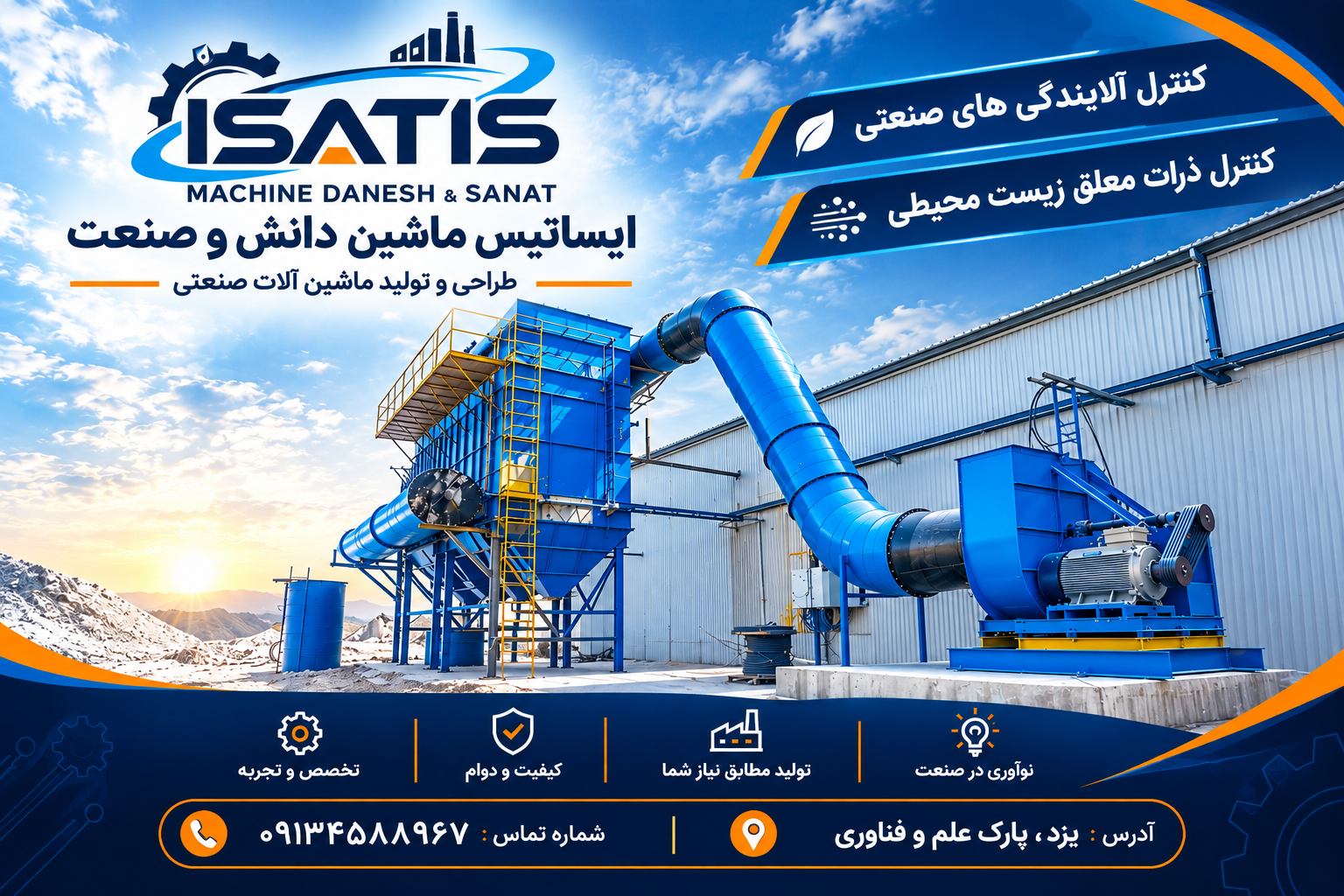

Manufacturing Industrial Dust Collectors: A Comprehensive Solution for Dust Control in Factories
Design and manufacture of industrial machinery
In many factories and industrial facilities, the generation of dust and airborne particles is a major source of workplace and environmental pollution. Utilizing a suitable industrial dust collector can help improve ambient air quality, reduce pollutant emissions, and enhance production process efficiency by capturing these airborne particles.
Manufacturing an industrial dust collection system requires a careful assessment of the type of contamination, particle quantity and size, required airflow volume, and production process conditions, as well as the proper selection of extraction and filtration equipment. An industrial dust collection system will perform effectively only when all its components are designed and selected in a coordinated manner.
What is an industrial dust collector?
Industrial Dust Collector It is a device used to collect and separate dust and airborne particles in industrial environments. This system typically consists of components such as hoods or suction points, ductwork, an exhaust fan, and equipment for filtration and dust collection.
In a standard system, contaminated air is drawn from dust-generating points, and after passing through filtration equipment, particles are separated from the airflow. Finally, the purified air is discharged from the system.
Main components of an industrial dust collector
The design and construction of an industrial dust collector are not limited merely to the selection of a filter; the system's proper operation depends on the coordination of all its components.
- Industrial suction system
An industrial extraction system is responsible for collecting contaminated air and particles generated at the production site and directing them toward the filtration unit. The proper design of extraction points and airflow paths has a direct impact on the performance of the entire system.
- Suction fan
Suction fan It is responsible for generating airflow and overcoming the pressure drop across ducts, filters, and other equipment. The selection of the appropriate fan capacity and pressure must be based on system engineering calculations.
- Ducting and Piping
Ducting serves as the pathway for transporting contaminated air from the source of generation to the dust collector. Poor duct design can lead to increased pressure drop, reduced suction, and the accumulation of particles within the system.
- Filtration equipment
The filtration section is responsible for separating particles from the airflow. The type of filter must be selected based on dust characteristics, air temperature, pollution levels, and process conditions.
- Bag filter
Bag filter It is a common piece of equipment in industrial dust collection systems used to separate solid particles from an airflow. In this process, dust-laden air passes through the surface of filter bags, and the particles accumulate on the filter surface.
The selection of bag material and quantity, the filtration area, and the filter cleaning method are important factors in the design of bag filters.
- Dust collection and discharge system
Particles separated from the airflow must be collected and discharged in a designated section. The type of discharge system depends on the dust quantity and the production process conditions.
The Role of Bag Filters in Industrial Dust Collection Systems
In many industries, Bag filter It serves as the primary filtration component. The operation of this equipment is based on passing airflow through bag filters and separating suspended particles.
To achieve optimal performance, factors such as the type of filter fabric, particle size, gas temperature, air velocity through the filter, and the cleaning method must be considered during the design process.
Therefore, when manufacturing an industrial dust collector, the choice of bag filter must be tailored to the actual conditions of the production line; a single type of filter cannot be used universally across all industries and processes.
How is industrial filtration carried out?
Industrial filtration is a process for separating solid particles or other contaminants from an airflow or gas stream. In dust collection systems, contaminated air is first captured by a suction system and then enters the filtration section.
During the filtration stage, particles remain on the filter surface, and the airflow exits the system with a reduced level of contamination after passing through the filter.
Proper filtration design depends on factors such as the following:
Particle type and size
Dust generation rate
Airflow temperature
Required air volume
System pressure and pressure drop
Type of industrial process
Filter Material and Characteristics
Stages of Designing and Manufacturing an Industrial Dust Collector
To construct an efficient industrial dust collector, the process conditions and the source of pollution generation must first be examined.
1. Investigation of the dust source
First, the locations where dust is generated are identified. These points may include production machinery, material transfer and discharge systems, mills, packaging lines, and other industrial areas.
2. Determining the required amount of air
Once the pollution sources have been identified, the volume of air required for extraction at each point is calculated. The sum of these values is crucial in determining the capacity of the extraction system and the fan.
3. Ductwork Design
The ductwork layout must be designed to ensure proper airflow and minimize system pressure drop as much as possible.
4. Selection of filtration equipment
Appropriate filtration equipment is selected based on the type and quantity of particles. In many industrial applications, the bag filter is one of the options used for particle collection.
5. Selecting the exhaust fan
The fan must be selected based on the required airflow rate and the total system pressure drop. An incorrect fan selection can lead to reduced suction power or increased energy consumption.
6. Fabrication and installation of equipment
Once the design is finalized, the equipment is manufactured and installed at the project site. The proper execution of connections, ducts, and suction points plays a crucial role in the system's final performance.
Applications of Industrial Dust Collectors in Factories
Industrial dust collection systems are used in various industries, including:
Tile and Ceramic Industries
Food Industry
Mineral Industries
Cement Industries
Materials Processing Industries
Material transfer and transport lines
Dusty manufacturing plants
Industrial environments containing suspended particles
The type of machinery and equipment used must be designed to suit the conditions of each factory and production process.
Benefits of Using an Industrial Dust Collection System
Using a suitable dust collection system can offer various benefits to an industrial unit, including:
Reduction of dust and suspended particulate matter emissions
Improving workplace air quality
Pollution control at the source
Collection of recyclable materials and particles
Reduction of material waste in certain manufacturing processes
Helping to maintain equipment and the factory environment
Creating more favorable conditions for the production process
The Importance of Custom Design in the Manufacturing of Dust Collection Systems
Each factory has its own specific conditions. The type of material, the volume of dust generated, process temperature, the number of extraction points, the ducting layout, and installation site constraints can all influence the system design.
For this reason, the construction of an industrial dust collector must be based on actual project data and engineering calculations. Selecting equipment without regard for production line conditions can lead to reduced suction and filtration efficiency.
Conclusion
An industrial dust collection system is an integrated assembly comprising a suction system, fan, ductwork, filtration equipment, and a dust collection unit. The proper selection of these components and a design tailored to the facility's specific conditions play a crucial role in controlling dust and airborne particulates.
Isatis Machine Danesh va Sanat specializes in the design and manufacture of industrial equipment and systems—including industrial dust collectors, industrial suction systems, pollution control units, and industrial filtration systems—and designs and implements dust collection solutions tailored to specific project requirements.